

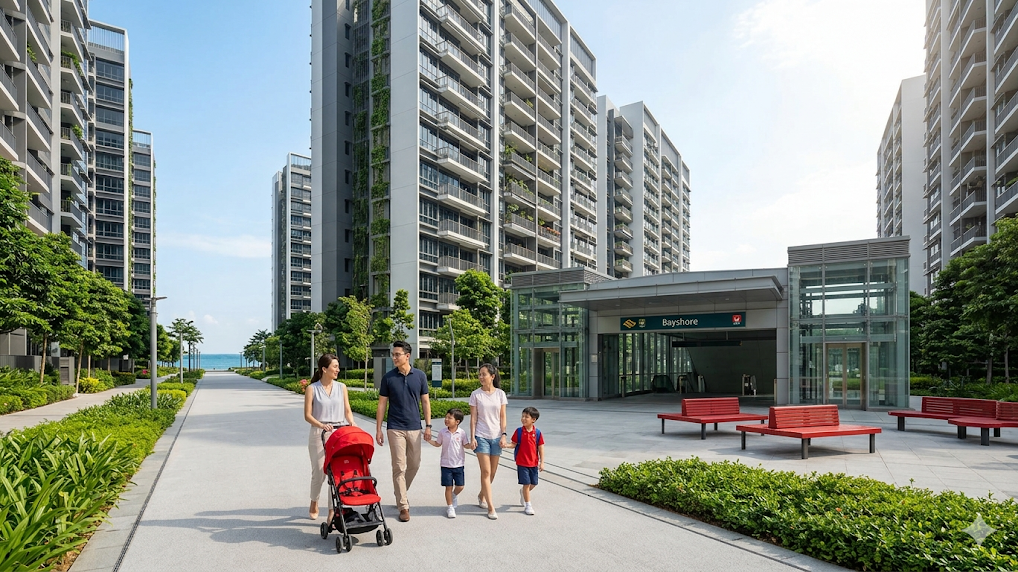
The East Coast of Singapore has traditionally been characterised by established private residential enclaves and legacy condominium developments. However, the Urban Redevelopment Authority (URA) is currently executing a massive structural shift in the region’s urban fabric. The development of the new Bayshore precinct marks the most significant injection of residential supply into District 16 in decades.
By integrating brand new public housing alongside future private developments, all anchored by the Thomson-East Coast Line (TEL), the government is fundamentally redefining the demographic and valuation baseline of the area. For prospective buyers, Bayshore is not just a new neighbourhood; it is a highly calculated urban node that requires a long-term strategic approach.
The Infrastructure and Valuation Premium
As the Bayshore precinct officially takes shape in 2026, the primary driver of its real estate value is the seamless integration of transport infrastructure. The operational Bayshore and Bedok South MRT stations effectively eliminate the historical reliance on feeder buses that defined older parts of the East Coast.
Properties situated within direct walking distance of a major rail network inherently command a valuation premium. For institutional developers planning future private launches in the precinct, and for existing resale condominium owners in the immediate vicinity, this newly activated connectivity serves as a strong catalyst for capital appreciation. The area is transitioning from a car-dependent district to a highly connected transit-oriented node.
Navigating the ‘Plus’ Classification in Bayshore
The most critical factor for first-time buyers evaluating the Bayshore precinct is the classification of its public housing. Because of the area’s premium waterfront location and direct MRT access, new Build-To-Order (BTO) projects launched here operate strictly under the "Plus" housing model.
This classification directly impacts a household’s long-term capital mobility. Buyers must adhere to a mandatory 10-year Minimum Occupation Period (MOP). Furthermore, upon selling the property on the open market, owners are subject to a subsidy recovery mechanism—a fixed percentage of the resale price that must be returned to the Housing & Development Board (HDB).
While the initial purchase price is heavily subsidised, families must factor this eventual capital reduction into their long-term financial modelling. The 10-year MOP means that a couple purchasing a Bayshore flat in their late twenties will be approaching their forties before they can unlock their home equity to fund a private condominium downpayment.
Strategic Implications for Upgraders
Consider the practical timelines for families looking to establish a presence in the East Coast.
A household seeking immediate upgrading flexibility might choose to bypass the new Bayshore BTOs entirely. Instead, they might utilise their combined cash and Central Provident Fund (CPF) Ordinary Accounts to purchase an older, existing resale condominium in the surrounding District 15 or 16. While this requires a heavier initial debt burden, the property is not bound by a 10-year MOP or a subsidy recovery mechanism. The family retains full control over their net proceeds and can restructure their portfolio whenever market conditions dictate.
Conversely, a family prioritising brand-new amenities, waterfront proximity, and a highly subsidised entry price will find Bayshore to be a premier choice. They accept the strict "Plus" regulations in exchange for securing a highly desirable address with minimal initial cash outlay, using the extended 10-year occupation period to aggressively accumulate CPF and cash reserves.
The Impact on Existing East Coast Supply
For current property owners in adjacent estates like Bedok or the older stretches of Upper East Coast Road, the development of Bayshore is a net positive. The injection of new retail amenities, widened pedestrian promenades, and enhanced transport links will create a positive "ripple effect." As the new precinct establishes higher price benchmarks, surrounding older properties typically see a defensive uplift in their valuations, solidifying the East Coast as a resilient wealth-preservation zone.
The Bottom Line
The Bayshore precinct represents a masterclass in modern urban planning, offering unparalleled connectivity and lifestyle integration along the East Coast. However, the regulatory structure of the "Plus" model ensures it is a destination for long-term owner-occupation rather than rapid capital flipping.
Before committing to this emerging precinct, clearly define your 15-year property timeline. Speak with a specialised property agent to project how a 10-year MOP and the mandated subsidy recovery will impact your specific family upgrading trajectory versus purchasing an unrestricted resale property in the same district.
Disclaimer: The information is provided for general information only. PropertyGuru Pte Ltd makes no representations or warranties in relation to the information, including but not limited to any representation or warranty as to the fitness for any particular purpose of the information to the fullest extent permitted by law. While every effort has been made to ensure that the information provided in this article is accurate, reliable, and complete as of the time of writing, the information provided in this article should not be relied upon to make any financial, investment, real estate or legal decisions. Additionally, the information should not substitute advice from a trained professional who can take into account your personal facts and circumstances, and we accept no liability if you use the information to form decisions.