

Many residents feel unsure about what happens during an HDB upgrading programme, especially with ageing flats and rising maintenance needs. If you’re wondering how the HDB HIP schedule 2026 works, what improvements are included, or when your block might appear in the 2026 schedule, you’re not alone. The process can seem confusing, from costs to disruptions and eligibility.
This guide simplifies everything with clear explanations, updated 2026 insights, and answers to common homeowner questions. Whether you’re preparing for upgrades or just want to understand how HIP supports your home, this article gives you the clarity and confidence you need.
Table of Contents
1. What is the HDB Home Improvement Programme (HIP)?
2. How HDB Upgrading Differs from BTO and Resale Flat Improvements?
3. Do All Flat Types Qualify for the HDB HIP Schedule 2026?
4. 2026 HIP Upgrading Schedule: Which Towns and Blocks Are Next?
5. How does the HIP Selection and Balloting Process Work?
6. Financing and Subsidies: How Much Do You Pay?
7. Step-by-Step Guide: What to Expect Before, During & After HIP
8. Benefits of HDB Upgrading for Long-Term Home Comfort
9. What Does This Upgrading Mean for Homeowners?
1. What is the HDB Home Improvement Programme (HIP)?
2. How HDB Upgrading Differs from BTO and Resale Flat Improvements?
3. Do All Flat Types Qualify for the HDB HIP Schedule 2026?
4. 2026 HIP Upgrading Schedule: Which Towns and Blocks Are Next?
5. How does the HIP Selection and Balloting Process Work?
6. Financing and Subsidies: How Much Do You Pay?
7. Step-by-Step Guide: What to Expect Before, During & After HIP
8. Benefits of HDB Upgrading for Long-Term Home Comfort
9. What Does This Upgrading Mean for Homeowners?
What is the HDB Home Improvement Programme (HIP)?
The HDB Home Improvement Programme (HIP) is an upgrading scheme introduced to address common ageing issues found in older HDB flats. It focuses on essential repairs that keep homes safe, comfortable, and functional as they age.
Instead of homeowners handling maintenance on their own, HDB coordinates the entire process block by block, making it easier and more affordable for residents.
HIP mainly covers three areas: repairing structural wear and tear, improving bathrooms, and fixing issues that affect safety or daily use. Residents can also choose extra upgrades, such as new doors or better bathroom fittings, at a subsidised cost.
The programme ensures that older estates remain liveable and well-maintained without placing a heavy burden on homeowners. It is one of Singapore’s most significant public housing initiatives, designed to enhance comfort while keeping household costs manageable.
How HDB Upgrading Differs from BTO and Resale Flat Improvements?
HDB upgrading differs from BTO and resale flat improvements mainly in purpose, scope, and timing. HDB upgrading refers to government-initiated programs to improve the facilities and infrastructure of existing flats. In contrast, BTO and resale flat improvements are typically owner-initiated renovations to customise or modernise their homes.
Initiator
Government (HDB)
Homebuyer (new flat owners)
Homeowner of the existing flat
Purpose
Enhance building facilities, infrastructure, and standard upgrades
Customise and furnish a new flat
Renovate to modernise, repair, or redesign
Scope
Standard and structural upgrades (e.g., lift upgrading, piping, bathrooms)
Interior finishing from scratch (flooring, kitchen, bathrooms)
Extensive renovation possible (demolition, rewiring, re-plumbing)
Timing
After a few years in older estates
Before moving in (during/after construction)
Anytime when homeowner decides
Cost borne
Subsidised or partially covered by the government
Paid by homeowner
Paid by the homeowner
Renovation freedom
Limited to approved upgrades
High flexibility in design and layout
High flexibility, but constrained by existing structure
Example programs
Home Improvement Programme (HIP), Main Upgrading Programme (MUP)
Custom installation of fixtures, personal design choices
Major refurbishments, interior redesign
HDB upgrading focuses on improving flats and estates for existing residents, ensuring safety, convenience, and value enhancement, often with some cost support from HDB. In contrast, BTO improvements are about personalising a brand-new home before moving in, and resale flat improvements are owner-driven renovations that can be more extensive to modernise older flats or suit specific lifestyle needs.
Do All Flat Types Qualify for the HDB HIP Schedule 2026?
Not all flat types automatically qualify for the 2026 HDB Home Improvement Programme (HIP) upgrading schedule. Eligibility primarily depends on the age of the flats and whether they have undergone previous upgrading programmes. Here is a detailed table summarising the qualification criteria for different flat types in 2026 based on available data:
One, two, three-room flats
Built in 1997 or earlier
Eligible if at least 30 years old
These flats are the primary focus of the 2026 upgrade schedule; many have been selected
Four-room flats
Built in 1997 or earlier
Eligible if at least 30 years old
Included in the latest HIP rounds, subject to age and polling approval
Five-room flats
Built in 1997 or earlier
Eligible if at least 30 years old
Similar eligibility, with optional improvements subsidised at a different rate
Executive flats
Built in 1997 or earlier
Eligible if at least 30 years old
Also covered under HIP with subsidies according to flat type
Flats built after 1997
N/A
Not eligible
Flats newer than 1997 generally do not qualify for HIP
Flats already upgraded
N/A
Not eligible if upgraded under previous schemes
Flats that have undergone the Main Upgrading Programme (MUP) or earlier HIP rounds are excluded.
Find the right HDB home for your needs.
Check out the latest listings today.
2026 HIP Upgrading Schedule: Which Towns and Blocks Are Next?
The towns and blocks included in the 2026 HDB Home Improvement Programme (HIP) upgrading schedule are determined based on the most recent information released. This section highlights the areas scheduled for upgrades, giving homeowners a clearer view of what to expect for their block in the upcoming cycle.
| Town | Blocks Selected for 2026 HIP Upgrades (Sample Clusters) |
| Bedok | Blks 633 – 649 Bedok Reservoir Road, Jalan Tenaga |
| Bukit Batok | Blks 623 – 628 & 297 – 299 Bukit Batok Central/Street 22 |
| Bukit Merah | Blks 6, 122, 123 & 125 Kim Tian Road |
| Bukit Panjang | Blks 501 – 512 Jelapang Road |
| Chua Chu Kang | Blks 429 – 441 Choa Chu Kang Ave 4; Blks 601 – 616 Choa Chu Kang Street 62; Blks 617 – 621 & 625 – 627 Choa Chu Kang Nth 7/Street 62; Blks 784 – 792 Choa Chu Kang Drive/Nth 6 |
| Clementi | Blocks within mature estates, exact blocks pending announcement |
| Hougang | Blks 567 – 580 Hougang Street 51/Ave 4 |
| Jurong West | Blks 345 – 355 Kang Ching Road/Corporation Drive; Blks 701 – 710 Jurong West Street 71; Blks 854 – 866 Jurong West Street 81; Blks 687 – 696 Jurong West Central 1 |
| Pasir Ris | Blks 130 – 137 Pasir Ris Street 11; Blks 252 – 257 & 266 – 275 Pasir Ris Street 21; Blks 138 – 161 Pasir Ris Street 11/13; Blks 626 – 633 & 642 – 651 Pasir Ris Drive 3/10; Blks 634 – 641 Pasir Ris Drive 1; Blks 601 – 615 Elias Road; Blks 570 – 586 Pasir Ris Street 53 |
| Queenstown | Blks 80 – 83 Strathmore Avenue |
| Sengkang | Blks 133 – 141 Rivervale Street |
| Tampines | Blks 324 – 337 Tampines Street 32; Blks 842B, 842C, 842D, 842E, 842F, 842G, 842H, 856B, 856C, 856D, 856E & 856F Tampines Street 82; Blks 338 – 343 & 345 – 351 Tampines Street 33; Blks 497A, 497B, 497C, 497D, 497F, 497G, 497H, 497J, 498A, 498B, 498D, 498E, 498F, 498G, 498H, 498J, 498L & 498M Tampines Street 45 |
| Toa Payoh | Blks 153A, 153 – 156, 171, 172, 172A, 97, 99A, 99B, 99C, 101A & 101B Lor 1/2/3 Toa Payoh |
| Woodlands | Blks 891A, 891B, 892A, 892B, 893A, 893B, 893C, 893D, 894A, 894B, 894C & 894D Woodlands Drive 50; Blks 728 – 743 Woodlands Circle; Blks 721 – 727 Woodlands Circle/Ave 6 |
| Others/Mature Estates | Various clusters in Clementi, Sembawang, Yishun, and other mature estates, as per future announcements and block-specific polling status |
Looking for more space for your family?
Explore HDB 4-room flats for sale across Singapore.
How does the HIP Selection and Balloting Process Work?
Understanding how the HIP selection and balloting process works helps residents know what to expect before upgrading begins. The system follows a precise sequence, from block selection to polling and final planning, ensuring that every step reflects the needs and approval of the community.
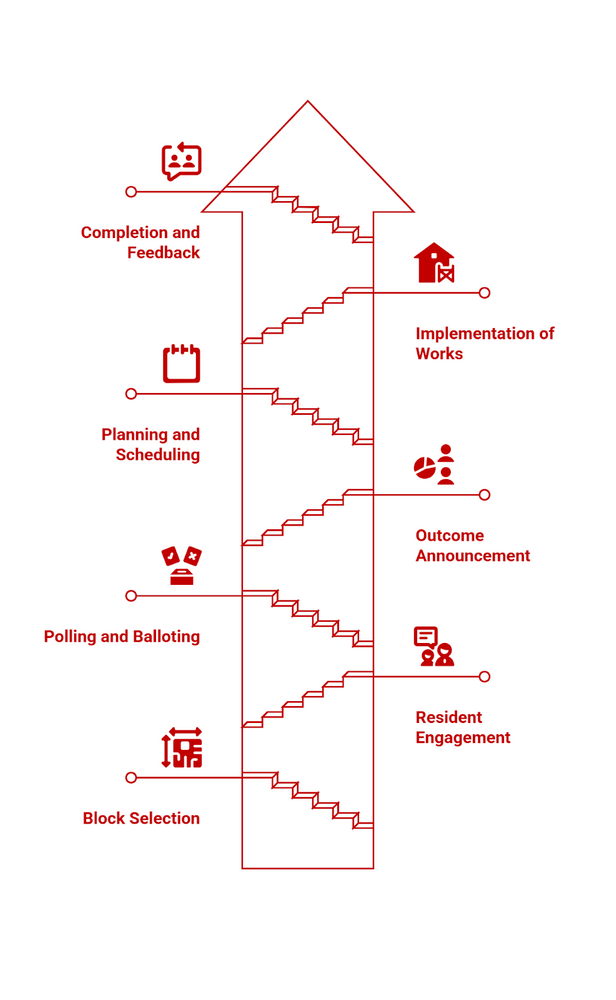
Step 1: Block Selection by HDB
HDB identifies flats that are generally 30 years or older and have not undergone major upgrading. Selected blocks are announced based on age, condition, and estate renewal priorities, followed by official notifications sent to residents through letters and public notices.
Step 2: Informing Residents and Survey Exercises
HDB conducts consultation sessions and surveys within the selected block. Residents receive information on essential, optional, and elder-friendly (EASE) improvements. The survey helps HDB understand preferences and prepare for the polling phase.
Step 3: Polling and Balloting
A poll is carried out among Singaporean citizen households in the block, while Permanent Residents and non-citizens do not vote. At least 75% approval from voting households is required for the upgrade to proceed. The poll covers essential works, optional items, and EASE items.
Step 4: After the Polling Outcome
If the poll passes, HDB begins planning and scheduling the works, keeping residents informed about timelines, scope, and payment details. If the survey fails, HIP is not carried out for the block at that point, although it may still be reviewed for future upgrade cycles.
Step 5: Planning and Scheduling of Works
Work is arranged in phases to minimise disruption. HDB coordinates contractors and sets timelines for each improvement. Residents receive a schedule indicating when their flats will undergo works.
Step 6: Implementation of Works
Essential upgrades include structural repairs, pipe replacements, electrical improvements, and bathroom renovation. Optional improvements and EASE features are added based on each household’s selections and payments. Renovation for each flat usually takes around ten days.
Step 7: Completion and Feedback
Once the works are completed, residents are given contact points to provide feedback or report defects. Any minor issues are resolved under the warranty period, and residents return to daily living with upgraded facilities that enhance overall home comfort.
Looking for an affordable and comfortable home?
Explore HDB 3-room flats for sale across Singapore.
Financing and Subsidies: How Much Do You Pay?
The government mostly subsidises the HDB Home Improvement Programme (HIP) in Singapore, but residents still bear part of the costs for optional upgrades, EASE features, and additional improvements. Below is a clear breakdown of how the costs are shared.
Essential Works
- Cost to residents: The government fully subsidises essential works.
- Includes: Structural repairs, pipe replacements, electrical upgrades, and other safety-related improvements.
- Payment: Residents do not pay for these works.
Optional Works
Residents pay between 5% and 12.5% of the optional upgrade costs, depending on flat type.
EASE (Enhancement for Active Seniors) Works
- Cost to residents: Residents pay between $125 and $312.50, depending on flat size.
- Coverage: These works cover features such as grab bars, ramps, and slip-resistant flooring.
- Government subsidy: The government subsidises 87.5% to 95% of these costs.
One, two, three-room
5%
$630
Smallest outlay, the government covers the rest
Four-room
7.5%
$945
Slightly higher contribution
Five-room
10%
$1,260
Moderate contribution
Executive
12.5%
$1,575
Highest resident share
HDB subsidises the remaining 87.5% to 95% of the cost.
Additional Costs
Households may opt for extra personalised upgrades that fall outside the HIP scope; residents fully pay for these.
Permanent Resident (PR) households pay the full cost of all improvements unless they obtain citizenship within one year of the billing date.
Note:
- The above costs are estimates based on current subsidy schemes. Actual costs may vary slightly depending on specific upgrades and contractor pricing.
- Residents should consult the official HDB portal or their estate’s upgrading office for precise figures tailored to their flats.
Need more room to live, work, and relax?
Explore HDB 5-room flats for sale across Singapore.
Step-by-Step Guide: What to Expect Before, During & After HIP
This guide outlines the whole process residents can expect throughout the HDB Home Improvement Programme (HIP), from early preparation to post-completion support.
Before HIP: Preparation and Notification
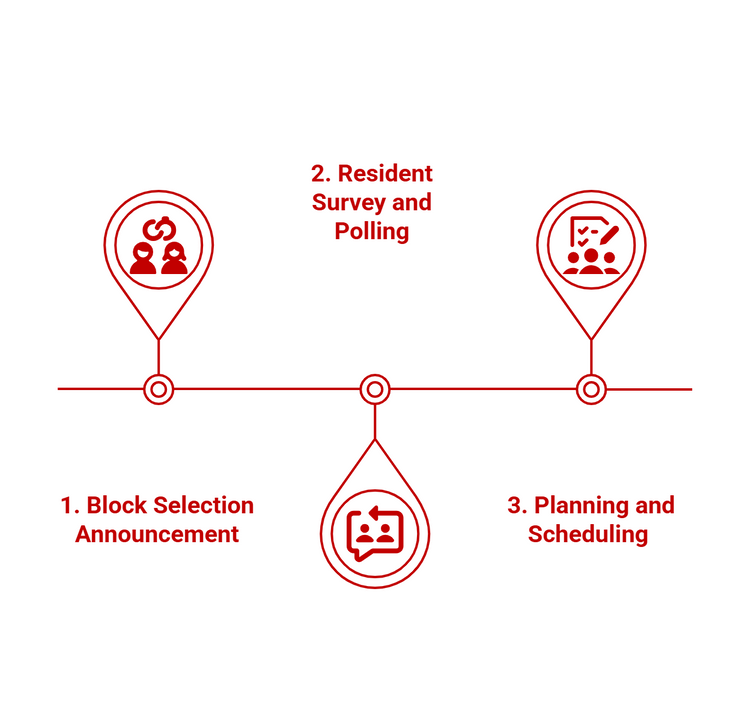
Block Selection Announcement
- HDB identifies blocks eligible for HIP, usually those over 30 years old.
- Residents receive official notification letters about the upcoming upgrading works.
- Information briefings and Q&A sessions are conducted to explain the programme scope and benefits.
Resident Survey and Polling
- Surveys are conducted to gauge interest in optional and elderly-friendly improvements.
- A poll is conducted, requiring at least 75% approval from Singapore households for HIP to proceed.
- Residents indicate which optional upgrades they would like to include.
Planning and Scheduling
- Once the poll is approved, HDB prepares the upgrade schedule.
- Tentative timelines, expected work phases and preparation guidelines are shared with residents.
During HIP: Upgrading Works (Typically 10 Working Days Per Flat)
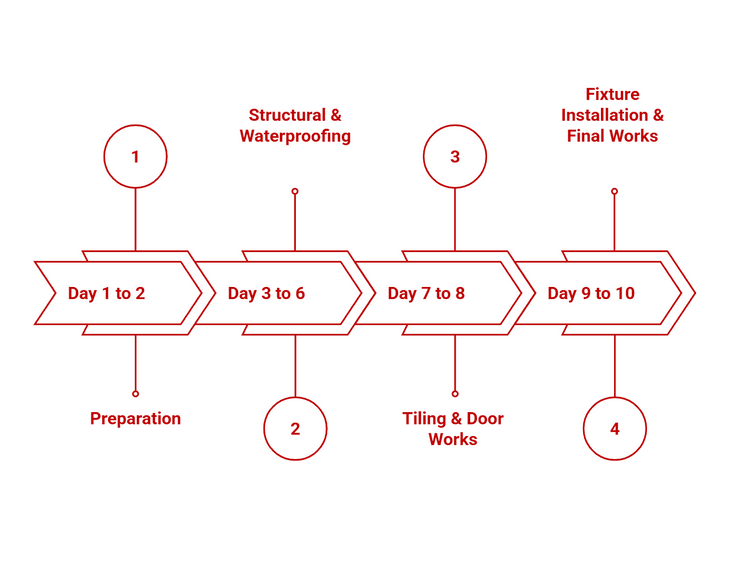
Day 1 to 2: Preparation and Initial Works
- Floor and wall protection is installed.
- Existing bathroom tiles and fixtures are removed.
- Portable toilets may be set up temporarily.
- Electrical rewiring and patch repairs begin.
Day 3 to 6: Structural and Waterproofing Works
- Repairs are carried out on spalling concrete areas.
- Soil and waste pipes are replaced.
- Waterproofing membranes are applied to bathroom floors and walls.
- The first water test is conducted to check for leaks.
Day 7 to 8: Tiling and Door Works
- New wall and floor tiles are installed in the bathroom and toilet.
- Measurements and installation of new fire-rated or non-fire-rated main doors and metal grille gates take place.
Day 9 to 10: Fixture Installation and Final Works
- Sanitary fittings, such as pedestal pans, wash basins, grab bars, and toilet doors, are installed.
- Main doors and frames are replaced or repainted.
- The portable toilets are removed, and the flat is cleaned.
- Final water tests and touch-up works, including slip-resistant treatments (if chosen), are completed.
- A handover and walkthrough are conducted for resident confirmation.
After HIP: Completion and Follow-up
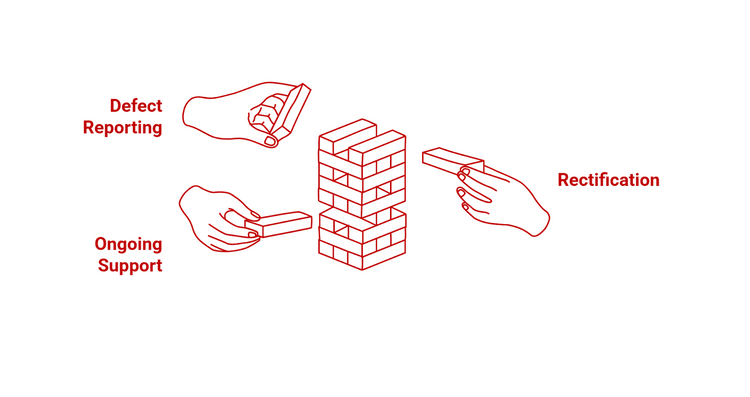
Defect Reporting and Rectification
- Residents may report minor defects during the warranty period.
- Contractors carry out rectification works as required.
- HDB conducts inspections to ensure quality and satisfaction.
Ongoing Support
- Residents receive contact details for assistance with post-HIP queries.
- Maintenance guidelines for EASE features and optional upgrades are provided.
Benefits of HDB Upgrading for Long-Term Home Comfort
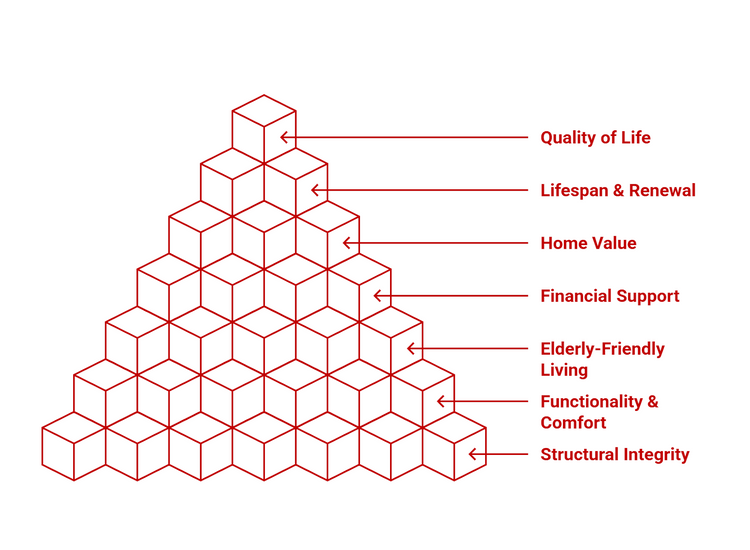
The HDB Home Improvement Programme (HIP) delivers long-term improvements that enhance comfort, safety, and daily living in older flats. By addressing common ageing-related issues, the programme helps residents enjoy a safer, more functional home environment.
- Enhanced Structural Safety and Integrity
HIP strengthens the overall condition of ageing flats by repairing spalling concrete, structural cracks and other wear-related issues. It also replaces deteriorated soil and waste pipes to prevent leaks and water damage, ensuring the building remains sound for years to come.
- Improved Home Functionality and Comfort
Upgrades include electrical load enhancements that enable the safe use of modern appliances without the risk of overload. Bathrooms receive new fixtures, improved waterproofing and slip-resistant surfaces, offering greater comfort and ease of use for daily routines.
- Elderly-Friendly Independent Living
The programme supports senior residents through EASE upgrades, including grab bars, ramps, and wider toilet entrances, to improve mobility and safety. Under the enhanced EASE 2.0 initiative introduced in 2023, additional features such as foldable shower seats and wheelchair-accessible paths provide even greater support.
- Financial Subsidies and Affordability
The government fully funds essential works for Singapore households. Optional improvements and EASE features are also heavily subsidised up to 95 per cent, making substantial upgrades accessible and affordable for most families.
- Increased Home Value and Marketability
Flats that undergo HIP often retain or increase in value due to improved infrastructure and modernised finishes. Prospective buyers appreciate flats that have been upgraded, which enhances marketability and resale appeal.
- Prolonged Flat Lifespan and Estate Renewal
The programme extends the lifespan of older flats by ensuring they remain safe, functional and relevant for decades. It also contributes to the rejuvenation of entire estates, enhancing aesthetics and fostering stronger community pride.
- Better Quality of Living and Peace of Mind
Residents benefit from fewer maintenance issues, safer electrical systems and better-designed living spaces. These enhancements offer a more comfortable and secure home environment, giving households confidence in the long-term liveability of their flats.
The benefits of HDB upgrading ultimately go beyond improved fixtures and structural fixes. They create safer, more comfortable homes that support daily living for all age groups. With substantial financial support and thoughtful enhancements, these upgrades help residents enjoy long-term comfort, better functionality, and greater peace of mind.
What Does This Upgrading Mean for Homeowners?
The HDB upgrading programme enhances comfort, safety, and long-term liveability for residents. With thoughtful improvements and strong financial support, homeowners can enjoy a more functional space, fewer maintenance concerns, and greater confidence in the value and longevity of their homes.
For more property news, content and resources, check out PropertyGuru’s guides section.
Looking for a new home? Head to PropertyGuru to browse the top properties for sale in Singapore.
Disclaimer: The information is provided for general information only. PropertyGuru Pte Ltd makes no representations or warranties in relation to the information, including but not limited to any representation or warranty as to the fitness for any particular purpose of the information to the fullest extent permitted by law. While every effort has been made to ensure that the information provided in this article is accurate, reliable, and complete as of the time of writing, the information provided in this article should not be relied upon to make any financial, investment, real estate or legal decisions. Additionally, the information should not substitute advice from a trained professional who can take into account your personal facts and circumstances, and we accept no liability if you use the information to form decisions.