
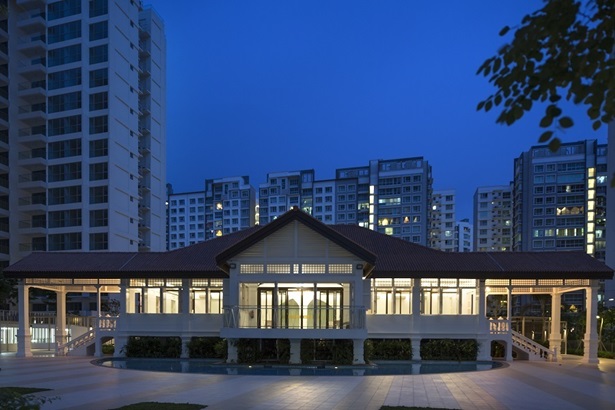
The refurbished Matilda House at A Treasure Trove. (Photo: Sim Lian Group)
After years of neglect, some of Singapore’s historic landmarks are getting a new lease of life and becoming part of condominium projects. We investigate.
By Romesh Navaratnarajah
In Singapore, there are so many residential projects to choose from that prospective buyers are spoilt for choice when it comes to purchasing a home.
And with more condominiums and apartments being launched in the market each year, the challenge for property developers is how to make their projects stand out from the rest. Some builders have come up with creative ideas to grab attention, such as building edible gardens, and bicycle stations.
Others have embarked on grander projects, like acquiring conservation bungalows and shophouses with the aim of incorporating them into the development’s design. In recent years, two projects – A Treasure Trove and The Red House – have made the headlines after their developers acquired conservation buildings for integration into the new developments.
Bungalow to clubhouse
Completed in 2015, the 882-unit A Treasure Trove is located opposite Punggol MRT station. The condominium houses the approximately 4,489 sq ft Matilda House, the last historical bungalow in the Punggol area.
Named after the mother of a prominent Eurasian called Alexander Cashin, the bungalow was built in 1902 as a gift for his wife, but was later abandoned and acquired by the government in the 1980s. In 2000, the Urban Redevelopment Authority (URA) designated it for conservation.
Developer Sim Lian Group purchased the residential site in 2010 under certain conditions, to retain and restore Matilda House according to the URA’s conservation guidelines, and include it as part of the housing project. It has since been converted into a clubhouse with facilities such as a function room, reading room, lounge and gymnasium.
“Its distinctive architecture features entrances on both sides of the main building, raised floors, timber lattice, louvered windows and transoms to allow cross breezes within the building,” said a spokesperson from Sim Lian.
The move to breathe new life into the bungalow has won the support of many residents.
“Residents’ feedback on the clubhouse has been very positive. The history and memory of the grand Matilda House adds a distinctive character and identity to A Treasure Trove,” the spokesperson said.
“They also appreciate that the clubhouse is integrated with the drop-off area, serving as the first landmark visitors see when entering the development.
“The function rooms are frequently booked for holding birthday parties and family gatherings. The gymnasium is also regularly patronised by residents.”
Katong’s iconic bakery
Over in the Katong area, The Red House, an iconic red shophouse which used to house the famous Old Red House Bakery, will soon open as a residential-retail-lifestyle development.
Launched in 2013, the development consists of 42 residential units and a retail wing of six shophouses. Developed by Warees Investments, the property development arm of the Islamic Religious Council of Singapore (MUIS), the project is on track for completion by the second quarter of this year. The shophouses were declared as Wakaf (Islamic endowment) assets in 1957.
Responding to queries from PropertyGuru, a spokesperson from Warees Investments said The Red House may be the only residential development in Katong to retain the original design of the building.
“Coupled with various eateries, old shops and the I12 shopping mall, as well as upcoming hotel developments such as Hotel Indigo Singapore Katong and Holiday Inn Express Singapore Katong (which incorporates the old Joo Chiat Police Station into the hotel), the potential of living in historic Katong, while at the same time enjoying the various developments taking shape, is promising.
“The Red House is also 10 minutes’ drive from the city centre, connected by both the ECP and PIE. Come 2020, there will be two new MRT stations within walking distance, Amber and Marine Parade,” the spokesperson added.
Speaking to reporters after visiting the site in December 2015, Minister for Communications and Information and Minister-in-charge of Muslim Affairs Yaacob Ibrahim said: “This is a conserved building. We are able to maintain the façade, and as the architect explained, they work painstakingly to restore the frontage of the building, which I think is very important.
“The Red House of course is another icon, so I think we have done our part to make sure that the heritage of Joo Chiat and Katong is maintained.”
To “relive the good old days of Katong and preserve the character and heritage of the district”, a bakery will reopen at the Red House, added Warees Investments. Aside from selling bread, it will also feature a gallery as a tribute to the building’s history.

Artist’s impression of The Red House project in Katong.
Protecting our identity
Explaining the importance of protecting Singapore’s built heritage as part of urban planning and development, the URA said: “The conservation of these buildings and areas in the city and elsewhere in Singapore is testament to our rich architectural, historical and cultural heritage. Conserving and restoring our historic buildings also add to the distinctive character and identity of our city. More importantly, they give us a sense of history and memory, even as we move into the future.”
Aamer Taher, Principal of Aamer Architects, told PropertyGuru that he is seeing a growing number of projects incorporating conservation buildings, especially in areas with a rich heritage.
According to the URA’s conservation guidelines, these include the city’s oldest areas such as Boat Quay, Chinatown, Kampong Glam and Little India.
“In Asia, Singapore has been at the forefront of setting out guidelines and principles for conservation and integration of old buildings within the city,” said Taher.
For instance, under the current guidelines, a conservation bungalow located within a site allowed for flat or condominium development may be strata-subdivided into apartment units or converted to a clubhouse, said a circular from law firm Rodyk & Davidson LLP.
“The type of conservation guidelines imposed will depend on the type of conservation area where the property in question is situated.
“For instance, a developer would have greater flexibility in developing a house that is in a Residential Historic District such as Emerald Hill, as opposed to a house that is in a Historic District like Chinatown, where the strictest form of conservation is practised and the entire building is to be retained,” the firm added.
Sensitive design
Meanwhile, a spokesperson for the URA told PropertyGuru that the agency is happy to work with developers who are looking to incorporate conserved buildings into their new developments, as this will enable such structures to have continued relevance and use in today’s context.
“In general, the new developments should complement and enhance the conserved buildings. Through sensitive site planning and design, the new developments can accentuate and bring out the ‘flavour’ of the heritage buildings.
“As a guide, the new buildings should be sufficiently spaced away, and their scale must not overwhelm the conserved buildings. View corridors should also be safeguarded within the site, so these heritage buildings can be viewed and appreciated by the public from the streets.
“Conserved buildings must also be protected from damage by the surrounding new works while construction is in progress. Proposals will be rejected if they do not meet these criteria,” noted the spokesperson.
Other challenges include preserving the strength and stability of foundations of the existing old buildings, building below or over the existing buildings, incorporating growing traffic and parking needs, and to some extent, finding the right materials and parts, which may no longer be available, noted Taher.
In the case of Matilda House, thorough research and careful planning had to be undertaken to retain and restore its original structure and architectural elements, said Sim Lian’s spokesperson, adding that great care was also taken to ensure that the foundation and structure of the house was not compromised as piling works began on the site.
Architectural Heritage Awards
The URA noted that several projects that have incorporated conserved buildings into their developments have won awards. For example, Draycott 8, No.4 Draycott Drive, and 9 Tan Quee Lan Street, all private residential projects, have been awarded URA Architectural Heritage Awards for the quality of the restoration work to their conserved buildings.
Another awardee is 42 Cairnhill. This former home of prominent banker Tan Chin Tuan from the pre-World War II period, was carefully restored and integrated as a clubhouse into the residential development.
 |
|||
 |
This article was first published in the print version The PropertyGuru News & Views. Download PDF of full print issues or read more stories now! | ||