

Renting a home in Singapore over the last three years has been a deeply stressful experience. Every time a lease approached its end, tenants braced themselves for a painful conversation. Landlords held all the cards, often demanding steep rent increases simply because there were no other housing options available. If a tenant tried to negotiate, the landlord could easily find another person willing to pay the higher price within forty-eight hours.
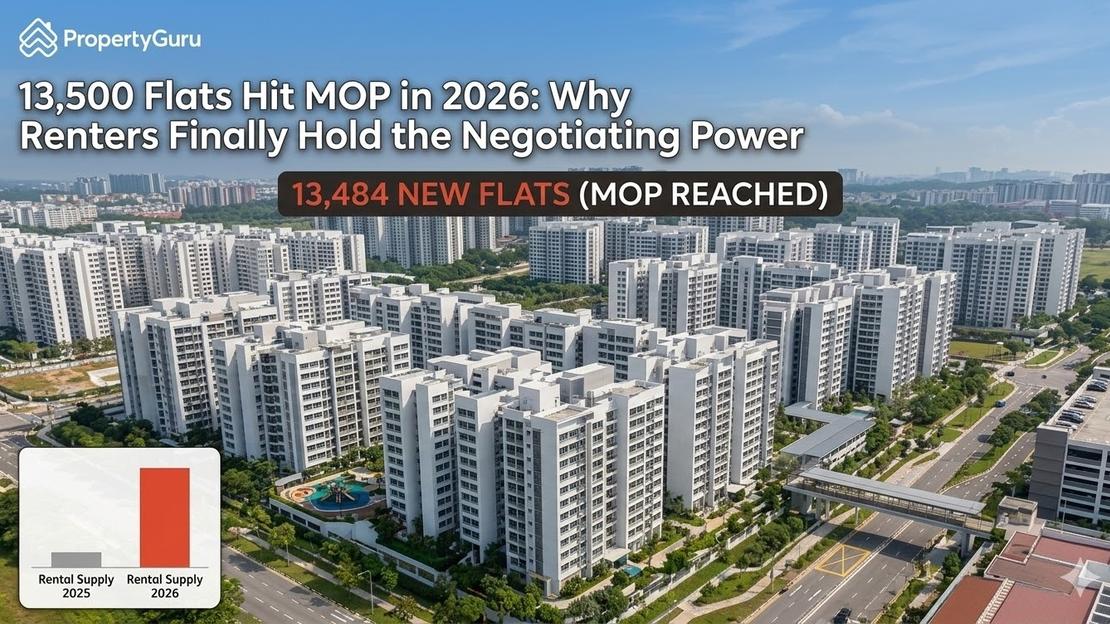
But the property market operates in distinct cycles, and the balance of power has just tilted in favour of the renter. When we examine the latest supply figures, the reality of the 2026 rental market becomes very clear. As of March 2026, exactly 13,484 HDB flats are reaching their Minimum Occupation Period (MOP). This is a massive 93% increase from the 6,970 units that achieved MOP status in 2025. Concentrated heavily in Punggol and Tampines, this surge shifts the leverage directly to tenants.
Understanding the Surge: What is MOP?
To understand where all these homes came from, we must first look at the rules of public housing. When a buyer purchases a new Build-To-Order (BTO) flat, they are legally required to live in the flat for an MOP of five years. This ensures public housing is used for living, not just for quick investment profits.
Several years ago, the government launched a building boom to meet housing demand. Fast forward to today, and the five-year timer for those flats is expiring. Exactly 13,484 units across 22 projects in 14 towns are suddenly "unlocked" and legally allowed to be rented out. When supply nearly doubles in a single cycle, landlords have to compete for you, not the other way around.
Geographical Concentration: The Punggol and Tampines Effect
This supply wave is not spread evenly across the island. While mature estates like Bishan or Marine Parade remain tight, the landscape in non-mature hotspots has transformed.
The 13,484 flats hitting the market are concentrated in specific areas:
- Punggol: Leads the surge with 3,222 units (primarily in the Northshore neighbourhood).
- Queenstown: Contributes 2,405 units (largely from the iconic Dawson "Sky" series).
- Tampines: Adds 2,133 units (concentrated in Tampines North).
In Punggol alone, thousands of owners who collected their keys in 2021 are now reaching their five-year mark. Many are upgrading while keeping their HDB as a rental asset, creating a rental glut. For a tenant, this means if a landlord refuses to budge on price, there are dozens of identical units in the same postcode currently seeking occupants.
The 1% Reality: Why Rental Growth Has Stalled
For the past few years, double-digit rental increases were common. But in 2026, the logic has flipped. With the 3-month compounded SORA stabilising at 1.11%, landlords no longer face the same aggressive mortgage pressure to hike rents.
More importantly, the sheer volume of new units creates a price ceiling. Property analysts now expect HDB rental growth to be capped at 1% for the year, with some peripheral estates even seeing a 1 to 2% softening. If a landlord tries to push for a high increase, they risk their unit staying empty for months. In the Singapore rental market, a two-month vacancy is far more expensive for a landlord than a $200 price reduction.
How Much Money Does This Save You?
Landlords are now far more willing to drop asking prices to secure a reliable tenant and avoid vacancy.
Assume you are currently paying $3,500 a month for a four-room flat. With the new competition, you have the leverage to negotiate. If you secure even a 6% reduction, your new rent drops to $3,290. This represents a direct saving of $210 every single month. Over a standard two-year lease, you will save a total of $5,040. While a successful negotiation is never a guaranteed outcome, the probability of securing a lower rate has reached a five-year high.
The Bottom Line
If you are a tenant in 2026, the days of accepting whatever price the landlord dictates are over. However, you must be strategic. The 13,484 flats are heavily concentrated in specific estates. Check the current listings in your specific block before you send a single text message to your landlord. The data proves that landlords are now competing for you. Ensure your wallet benefits from that competition by citing the MOP surge and the current stalled growth. The leverage has shifted; it is time to use it.
All data cited in this article are based on conditions and information available as of March 2026. This data may change as economic conditions and regulatory policies evolve.
Disclaimer: The information is provided for general information only. PropertyGuru Pte Ltd makes no representations or warranties in relation to the information, including but not limited to any representation or warranty as to the fitness for any particular purpose of the information to the fullest extent permitted by law. While every effort has been made to ensure that the information provided in this article is accurate, reliable, and complete as of the time of writing, the information provided in this article should not be relied upon to make any financial, investment, real estate or legal decisions. Additionally, the information should not substitute advice from a trained professional who can take into account your personal facts and circumstances, and we accept no liability if you use the information to form decisions.