

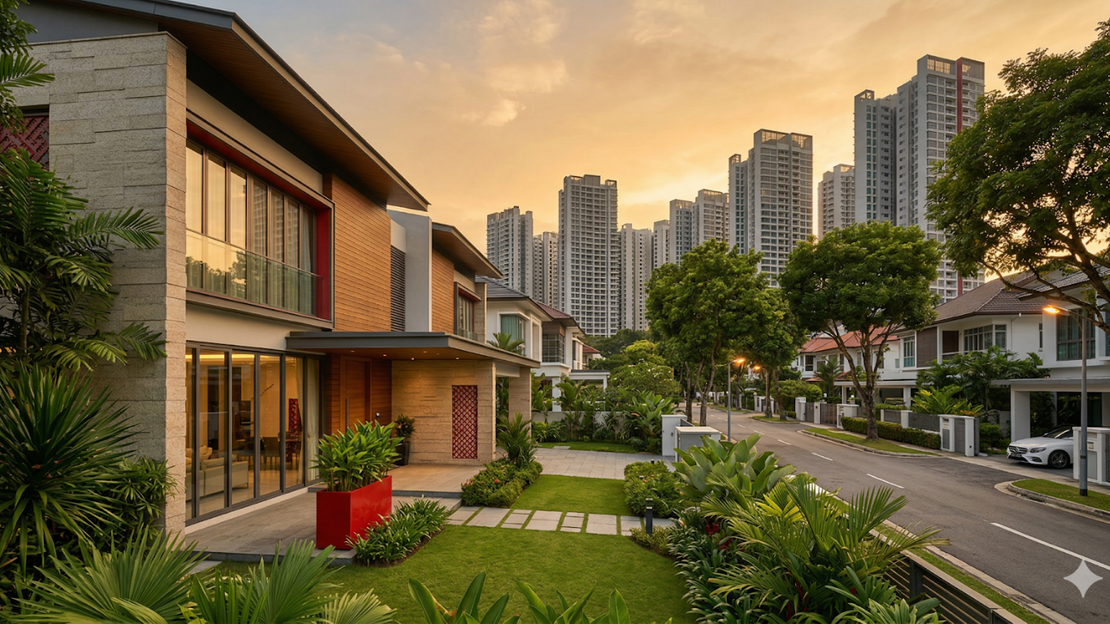
Buying a house with land attached is a major milestone for many families in Singapore. It offers space, privacy, and full autonomy over your physical environment. However, acquiring these homes is becoming an increasingly exclusive endeavour. While buyers watch new launch condominium prices closely, those looking for multi-generational family homes are making very different moves to secure space.
The latest market data shows a sharp divergence in buying behaviour. High-end buyers are moving their capital away from standard condominiums and directing it into freehold land. This specific asset class significantly outperformed the non-landed segment this quarter, proving that buyers with deep pockets are aggressively securing limited plots before they disappear from the open market.
The Urban Redevelopment Authority (URA) has released the latest property indices. The numbers show exactly where buyers are focusing their property searches.
Are landed property prices going up in Singapore?
As of January 2026, URA data shows that landed property prices rose by 3.4% quarter-on-quarter, significantly outperforming the non-landed segment. This reflects a growing urgency among buyers to secure long-term family homes in a highly restricted market.
The URA tracks these movements through the Property Price Index (PPI), and the current trajectory confirms a distinct shift in priorities. Securing a long-term family home is the primary driver. Buyers recognise that the government releases very little new land for terraced houses or bungalows. This highly restricted supply makes existing landed property a defensive asset against inflation.
How much extra capital do you need to enter the market today?
A 3.4% increase sounds modest on a spreadsheet, but the sheer quantum of these transactions makes it a massive financial hurdle in reality. If a terrace house in District 15 (East Coast) was valued at $4,000,000 late last year, a 3.4% jump adds $136,000 to the asking price in a single quarter.
Buyers must prepare much larger cash downpayments to cover this gap, usually funded through a mix of cash and Central Provident Fund (CPF) savings. They must also ensure their monthly income can support heavier mortgage repayments. When you buy a multi-million dollar asset, even a small percentage bump translates to decades of increased debt servicing.
The practical realities of upgrading to a landed home
Let us look at the practical choices facing buyers trying to navigate this market.
Many buyers decide to purchase an older, unrenovated semi-detached house in an outer district right now. They secure the land, accept the immediate 3.4% premium, and plan to rebuild the property in 3 to 5 years when their cash flow allows. By locking in the land value today, they protect themselves from future price spikes driven by scarcity. They now own a finite piece of Singaporean real estate.
Other buyers decide to wait for prices to cool down, parking their funds in a high-yield fixed deposit. While their money earns a safe return, the fresh supply of landed homes remains incredibly slow. If the market continues its upward trajectory driven by local buyers upgrading from public housing or condominiums, those who wait may find themselves priced out of the landed segment entirely.
The hidden risks to watch out for
The primary risk in buying older landed homes is the hidden cost of reconstruction. A $136,000 price jump is just the entry fee. Buyers frequently underestimate the capital and time required to rebuild an ageing property. Construction costs, material delays, and structural surprises can quickly drain your cash reserves and delay your move-in date by years.
Holding a large, highly illiquid asset also means your wealth is firmly tied down. If you face a sudden business downturn, selling a landed house takes significantly longer than liquidating a standard 2-bedroom condominium. You cannot simply cash out in a matter of weeks.
The Bottom Line
The landed housing segment operates by its own set of rules, completely detached from the broader public housing and standard private condo markets. The latest data proves that buyers with capital will always pay a premium for limited supply.
Take immediate stock of your CPF balances and liquid cash. Speak with an experienced property agent who specialises in landed homes to determine realistic asking prices in your preferred district, and focus your search on older properties with strong redevelopment potential.
Disclaimer: The information is provided for general information only. PropertyGuru Pte Ltd makes no representations or warranties in relation to the information, including but not limited to any representation or warranty as to the fitness for any particular purpose of the information to the fullest extent permitted by law. While every effort has been made to ensure that the information provided in this article is accurate, reliable, and complete as of the time of writing, the information provided in this article should not be relied upon to make any financial, investment, real estate or legal decisions. Additionally, the information should not substitute advice from a trained professional who can take into account your personal facts and circumstances, and we accept no liability if you use the information to form decisions.