


Figuring out whether you actually qualify for an HDB flat can feel confusing, especially with changing rules, new flat categories, and different schemes for BTO and resale buyers. Many people spend hours searching through scattered information, only to end up more unsure than before. This guide is designed to be your go-to solution. It gives you a clear and simple breakdown of everything you need to know about HDB flat eligibility in 2025, so you can make decisions confidently and plan your next move without the stress.
Table of Contents
What BTO Requirements Do You Need to Meet in 2025?
How Do I Check My HDB BTO Eligibility?
How Do HDB Eligibility Schemes Work in 2025?
What Documents Do I Need for a BTO Application?
Income Ceilings and How They Affect Eligibility
Minimum Occupation Period (MOP) and Its Importance in 2025
Recent Policy Updates and Their Implications for Buyers in 2025
What BTO Requirements Do You Need to Meet in 2025?
How Do I Check My HDB BTO Eligibility?
How Do HDB Eligibility Schemes Work in 2025?
What Documents Do I Need for a BTO Application?
Income Ceilings and How They Affect Eligibility
Minimum Occupation Period (MOP) and Its Importance in 2025
Recent Policy Updates and Their Implications for Buyers in 2025
Watch Our Video on HDB Flat Eligibility in Singapore
What BTO Requirements Do You Need to Meet in 2025?
Here is a detailed table of the BTO (Build-To-Order) flat eligibility requirements for 2025 in Singapore, without sources:
| Requirement Category | Details |
| Citizenship | At least one applicant must be a Singapore Citizen. The other applicant must be either a Singapore Citizen or a Permanent Resident (PR). |
| Age | Applicants must be at least 21 years old. Singles applying alone must be at least 35 years old. |
| Family Nucleus / Applicant Type | Applicants must qualify under one of the following schemes: Public SchemeFiancé/Fiancée SchemeOrphans SchemeNon-Citizen Spouse SchemeSingle Singapore Citizen Scheme or Joint Singles Scheme. |
| Property Ownership | Applicants and occupiers must not own private residential property locally or overseas, and must not have sold any private property in the last 30 months. Private property owners must dispose of their property within six months of taking the BTO flat. |
| Income Ceiling | Income limits: $14,000 for families; $21,000 for extended/multi-generation families; $7,000 for singles applying for two-room Flexi flats in non-mature estates. Income limits vary based on flat type and scheme. |
| Minimum Occupation Period (MOP) | A five-year MOP must be fulfilled before selling or renting the flat out. |
| BTO Application Requirements | Applicants must submit their application during a BTO launch and have a valid HDB Flat Eligibility (HFE) letter before submitting their application. |
| Other Eligibility Criteria | Applicants must not have taken two or more HDB housing loans. They must not have previously purchased multiple new HDB/DBSS flats or ECs, or received multiple CPF Housing Grants, unless permitted under specific conditions. |
How Do I Check My HDB BTO Eligibility?
To check your eligibility for a BTO (Build-To-Order) flat in Singapore in 2025, you can follow these steps:
- Visit the HDB’s official online eligibility checking e-Service or portal. This tool allows you to enter details for all applicants and occupiers you intend to include in the flat purchase.
- Provide required personal information such as citizenship status, age, marital status, family nucleus details (e.g., spouse, children, parents), income levels, and property ownership status.
- The system evaluates your input against HDB’s BTO eligibility criteria for flats, including citizenship requirements, age minimums, Approved Family Nucleus schemes, income ceiling limits, and property ownership restrictions (no current ownership or recent disposal of private property).
- The eligibility check will confirm if you meet the conditions to apply for a BTO flat. It will also indicate any applicable priority schemes or grants for which you may qualify.
- After confirming eligibility, you can then proceed to apply during official BTO launch periods using your eligibility letter (HDB Flat Eligibility letter) obtained from the check.
- Additionally, you can explore your housing loan options through the eligibility tool, including HDB loan eligibility or bank loan requirements.
By doing this pre-application BTO eligibility check online, you can be sure that you meet all key requirements before committing to apply, saving time and effort. The process ensures compliance with income, family, citizenship, and property ownership rules for BTO flats in 2025.
This digital eligibility tool and process are updated regularly by HDB and accessible via their website at the start of each BTO launch cycle. It is the most direct and reliable method to verify your HDB BTO eligibility before submission.
Plan your property finances with confidence.
Use our mortgage calculators and home loan tools.
How Do HDB Eligibility Schemes Work in 2025?
HDB eligibility schemes in 2025 are structured to cater to different categories of applicants, ensuring fair access to public housing based on family nucleus, citizenship, income, and other BTO criteria. These schemes define who can buy BTO (Build-To-Order) flats or resale flats. Here is a detailed explanation organised into subheaders and key points:
Public Scheme
- Designed for families or households forming a valid family nucleus.
- The family nucleus can include spouses and children, parents and siblings, or children in legal custody.
- At least one applicant must be a Singapore Citizen, and at least one other must be either a Singapore Citizen or a Permanent Resident.
- The income ceiling for families applying under this scheme is generally $14,000 average gross monthly household income ($21,000 if including extended/multi-generation households).
- Applicants must not own private property or have sold any in the last 30 months.
Fiancé/Fiancée Scheme
- Applicable to couples engaged to be married but not yet married at the time of application.
- Requires submission of the marriage certificate within three months after flat resale transactions.
- Same citizenship and income rules as the Public Scheme apply.
Single Singapore Citizen Scheme
- For unmarried/divorced Singapore Citizens aged 35 and above (orphans qualifying from age 21).
- Applicants can apply only for two-room Flexi flats in all locations (traditionally only mature estates, but since late 2024 also mature estates).
- Monthly income ceiling of $7,000.
- Singles pay a premium compared to families but may access special grants.
Joint Singles Scheme
- For groups of two to four single Singapore Citizens applying jointly to form a household.
- Co-applicants must all be Singapore Citizens.
- Average household income must not exceed $7,000 monthly.
- Applicable for buying flats suitable for multiple single occupants wanting to live together.
Non-Citizen Spouse Scheme
- For families where one spouse is a Singapore Citizen and the other is neither a Citizen nor a Permanent Resident.
- The non-citizen spouse must have a valid Long-Term Visit Pass or Work Pass.
- Eligible to apply for two-room Flexi flats only.
- Must be first-time applicants under this scheme.
Orphans Scheme
- Targets orphan siblings who want to buy a BTO flat together.
- At least one deceased parent must have been a Singapore Citizen or Permanent Resident.
- All siblings must be single and form the applicant group.
- Orphans can apply for flats from the age of 21.
Additional Notes on Eligibility Schemes
- Schemes have specific income ceilings tailored for family or single applicants.
- Applicants must satisfy property ownership restrictions (no private property ownership locally or internationally).
- Minimum Occupation Periods (MOPs) typically require flat occupation for 5 years before resale or rental.
- These schemes determine eligibility for housing grants and priority in BTO balloting.
- Eligibility schemes ensure housing is allocated fairly based on household type, income, and citizenship status.
What Documents Do I Need for a BTO Application?
When applying for a Build-To-Order (BTO) flat in 2025, you will need to prepare and submit various documents to prove your eligibility and complete your application. These documents are necessary during the application stage and subsequent flat booking appointment if your application is successful.
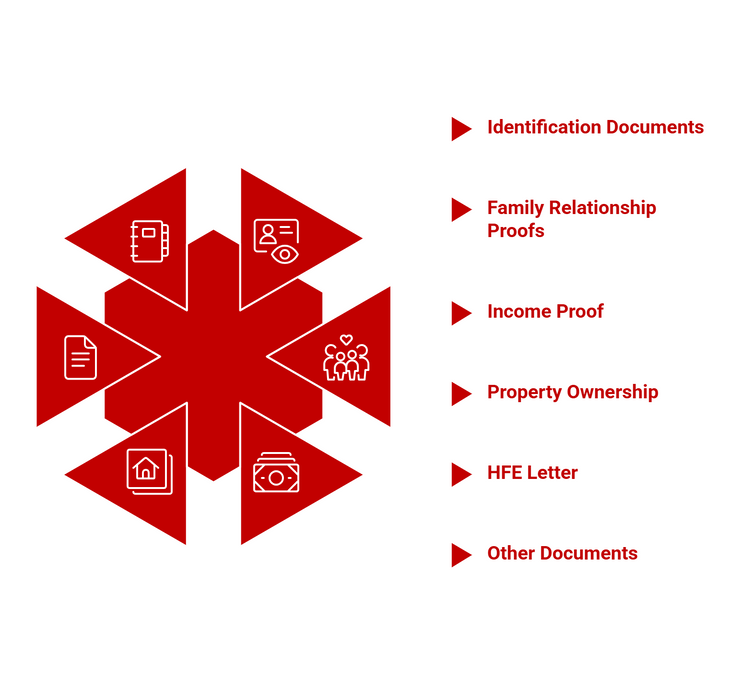
Key Documents Required:
- Identification Documents
- NRIC/Identification card for all applicants and essential occupiers.
- Digital IC verification via Singpass is often required for employment verification.
- A passport for any applicants who are permanent residents or foreigners.
- Family Relationship Proofs
- Marriage certificate if applying with a spouse.
- Birth certificates of children if applying with children or under multi-generation family schemes.
- Divorce certificate (if applicable), especially for divorced applicants applying with children.
- Death certificate (if applicable), for widowed applicants.
- Parents’ marriage certificate and your birth certificate for applications under the Multi-Generation Priority Scheme or Married Child Priority Scheme.
- Income Proof and Employment Details
- Recent payslips or income statements for all working applicants to prove household income does not exceed income ceilings.
- Employment letters or CPF contribution statements may be requested for income verification.
- Property Ownership and Sales Declaration
- Statutory declaration for non-ownership of private property locally or overseas.
- Proof of disposal if applicants have sold private property within the last 30 months.
- HDB Flat Eligibility (HFE) Letter
- Must be obtained and submitted before the application. It confirms eligibility to buy BTO flats and the CPF housing grants and loan amounts applicants qualify for.
- It is mandatory for the flat appointment.
- Other Supporting Documents
- Proof of Long-Term Visit Pass or Work Pass for non-citizen spouses under the Non-Citizen Spouse Scheme.
- Documents supporting any special schemes (e.g., Orphans Scheme, Joint Singles Scheme) as required.
Important Notes:
- All documents must be authentic and, where applicable, recent.
- Applicants should ensure they complete the application with accurate and consistent information.
- During the flat booking appointment, additional documents, such as payment receipts for option fees and loan application forms, will be required.
- Key dates for submitting documents are announced by HDB ahead of BTO launches; missing them can affect application processing.
Looking for extra space and comfort?
Browse HDB Executive Apartments for sale today.
Income Ceilings and How They Affect Eligibility
Income ceilings are one of the most critical factors determining eligibility for Build-To-Order (BTO) flats in Singapore in 2025. These ceilings define the maximum average gross monthly household income that applicants can earn to qualify for subsidised public housing, ensuring the apartments are allocated to those who need them most.
- Current Income Ceilings:
- $14,000 for most families applying for three-room flats and larger.
- $21,000 for extended or multi-generation families applying collectively.
- $7,000 for singles applying under the Single Singapore Citizen Scheme for two-room Flexi flats.
- Some three-room flats may cost $7,000 or less, depending on the project.
- Income Components Considered:
- HDB calculates applicants’ average gross monthly household income by combining salaries, bonuses, allowances, commissions, employer CPF contributions, rental income, and certain pensions or stipends, averaged over 12 months.
- Irregular income, like occasional overtime or one-time bonuses, may be excluded or averaged differently.
- Impact on Eligibility:
- If the household income exceeds the ceiling for the chosen flat type, the application will be disqualified even if other criteria are met.
- This ensures BTO flats remain affordable and accessible to lower- to middle-income Singaporeans.
- Reviews and Adjustments:
- The income ceilings were last revised in 2019 and are subject to future reviews to keep pace with economic changes and wage growth.
- As of late 2025, government officials have indicated possible upcoming adjustments to the income ceilings to reflect rising incomes while balancing housing affordability.
- Special Considerations:
- Extended families or multi-generation families submit combined incomes for all household members and must collectively meet the higher ceiling.
- Singles have a stricter ceiling but may benefit from enhanced housing grants.
- The income ceiling differs between Executive Condominiums (ECs) and resale flats: resale flats have no income ceiling.
- Practical Example:
- A couple earning a combined gross monthly income of $10,000 is well within the $14,000 ceiling and eligible to apply for standard four-room BTO flats.
- If their combined income exceeded $14,000, they would be ineligible for BTO flats, though resale flats or private housing remain options.
Looking for premium living with exclusive amenities?
Browse executive condos for sale today
Minimum Occupation Period (MOP) and Its Importance in 2025
The Minimum Occupation Period (MOP) refers to the number of years you must live in your HDB flat before selling it, renting out the whole unit, or buying a private property. The MOP begins the day you collect your keys, but any period spent away from the flat, such as living overseas, does not count.
Standard MOP Duration
Most BTO projects launched in 2025 come with a five-year MOP, regardless of whether you take an HDB or bank loan.
Most BTO projects launched in 2025 come with a five-year MOP, regardless of whether you take an HDB or bank loan.
Variations in MOP
- Flats classified as Prime or Plus under HDB’s new classification framework (introduced recently) may have longer MOPs of up to 10 years.
- Executive Condominiums (ECs) have a 5-year MOP, followed by an additional 5 years before complete privatisation and sale to foreigners.
- Resale flats with CPF housing grants also carry a five-year MOP.
- Flats purchased under special schemes such as the Fresh Start Housing Scheme may have a longer MOP of up to 20 years.
Importance of MOP
- Ensures that flats are primarily owner-occupied, supporting stable, sustainable public housing.
- Prevents speculative flipping or short-term renting, keeping flats affordable for genuine homeowners.
- Affects eligibility to purchase other residential properties; you cannot buy a second home (private property or HDB) before fulfilling MOP.
- Protects social objectives by encouraging long-term residence in HDB estates, fostering community cohesion.
Key Points to Remember
- You must physically reside in your flat; periods living overseas or renting out the entire flat do not count towards MOP.
- Selling, renting, or purchasing the entire flat or private property before MOP completion is against HDB rules and may result in penalties.
- Plan your housing and financing decisions with MOP timelines in mind to avoid complications.
Recent Policy Updates and Their Implications for Buyers in 2025
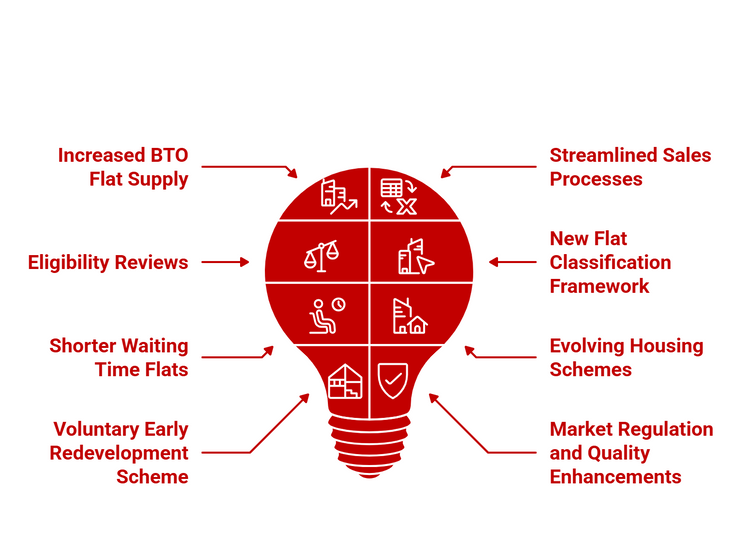
- Increased BTO Flat Supply
- HDB plans to raise the supply of BTO flats by 10% to about 55,000 units between 2025 and 2027, including launches in new areas like Mount Pleasant and Woodlands North Coast.
- This expansion aims to meet growing demand, especially from younger Singaporeans and smaller households, reducing pressure on resale flat prices and improving accessibility.
- Streamlined Sales of Balance Flats (SBF) and Open Booking of Flats (OBF)
- Since 2024, HDB has streamlined flat sales to a single SBF exercise and three BTO launches annually for greater predictability.
- SBF offers immediate-ready flats from unsold inventories, including flats across mature and non-mature estates, providing more location options but with higher competition.
- Unselected SBF flats may be released for OBF, available on a first-come, first-served basis, giving buyers another chance.
- Eligibility Age and Income Ceiling Reviews
- The government is reviewing lowering the minimum age for singles to apply for BTO flats, potentially allowing those under 35 to buy subsidised flats.
- There are ongoing discussions about raising income ceilings to reflect wage growth, which would widen eligibility but may increase demand for flats.
- Any increases will be balanced against the BTO supply to avoid overheating demand.
- Introduction of New Flat Classification Framework
- HDB now classifies flats into Standard, Plus, and Prime categories, with implications on pricing, design, and Minimum Occupation Periods (MOP).
- Prime and Plus flats may carry longer MOPs and target different buyer segments, offering choice but also influencing buyer obligations.
- Shorter Waiting Time (SWT) Flats
- In 2025, HDB plans to launch approximately 4,500 SWT flats with waiting times of under three years, exceeding its previous targets.
- This benefits buyers who need quicker move-ins, such as those with pressing housing needs or those who are upgrading quickly.
- Evolving Public Housing Schemes
- Enhanced support schemes, such as the Family Care Scheme, prioritise singles buying flats near their parents, recognising the changing dynamics of family life.
- The Fresh Start Housing Grant has been increased to support second-time families purchasing resale flats, enhancing affordability.
- Voluntary Early Redevelopment Scheme (VERS)
- Announced updates in 2025 indicate progress towards the 2030s rollout of VERS, enabling 70-year-old flats to be redeveloped via resident vote, with compensation related to remaining lease value.
- This scheme focuses on renewing mature estates while offering residents replacement housing nearby.
- Market Regulation and Quality Enhancements
- New developer regulations starting early 2026 will mandate more precise project details and improved quality checks to protect homebuyers.
- These aim to boost liveability and safeguard buyers amid rising housing supply across both the public and private sectors.
Implications for Buyers:
- Greater BTO supply and SWT flats mean more choices and shorter waiting periods.
- Possible changes to income ceilings and age eligibility may expand access but increase competition.
- Awareness of new flat classifications and MOP requirements is crucial for effective purchasing planning.
- Public schemes provide more support for diverse family scenarios, benefiting singles and second-time parents.
- Redevelopment initiatives promise renewal opportunities in mature estates but require attention to timelines and compensation details.
Together, these shifts point toward a more flexible, buyer-friendly housing landscape with broader eligibility and shorter waits. Staying updated on policy adjustments and new flat categories helps buyers plan confidently and secure options that suit their long-term needs. Overall, 2025 shapes up to be a year with greater clarity, choice, and support for different household types.
For more property news, content, and resources, check out PropertyGuru’s guides section.
Looking for a new home? Head to PropertyGuru to browse the top properties for sale in Singapore.
Disclaimer: The information is provided for general information only. PropertyGuru Pte Ltd makes no representations or warranties in relation to the information, including but not limited to any representation or warranty as to the fitness for any particular purpose of the information to the fullest extent permitted by law. While every effort has been made to ensure that the information provided in this article is accurate, reliable, and complete as of the time of writing, the information provided in this article should not be relied upon to make any financial, investment, real estate or legal decisions. Additionally, the information should not substitute advice from a trained professional who can take into account your personal facts and circumstances, and we accept no liability if you use the information to form decisions.